
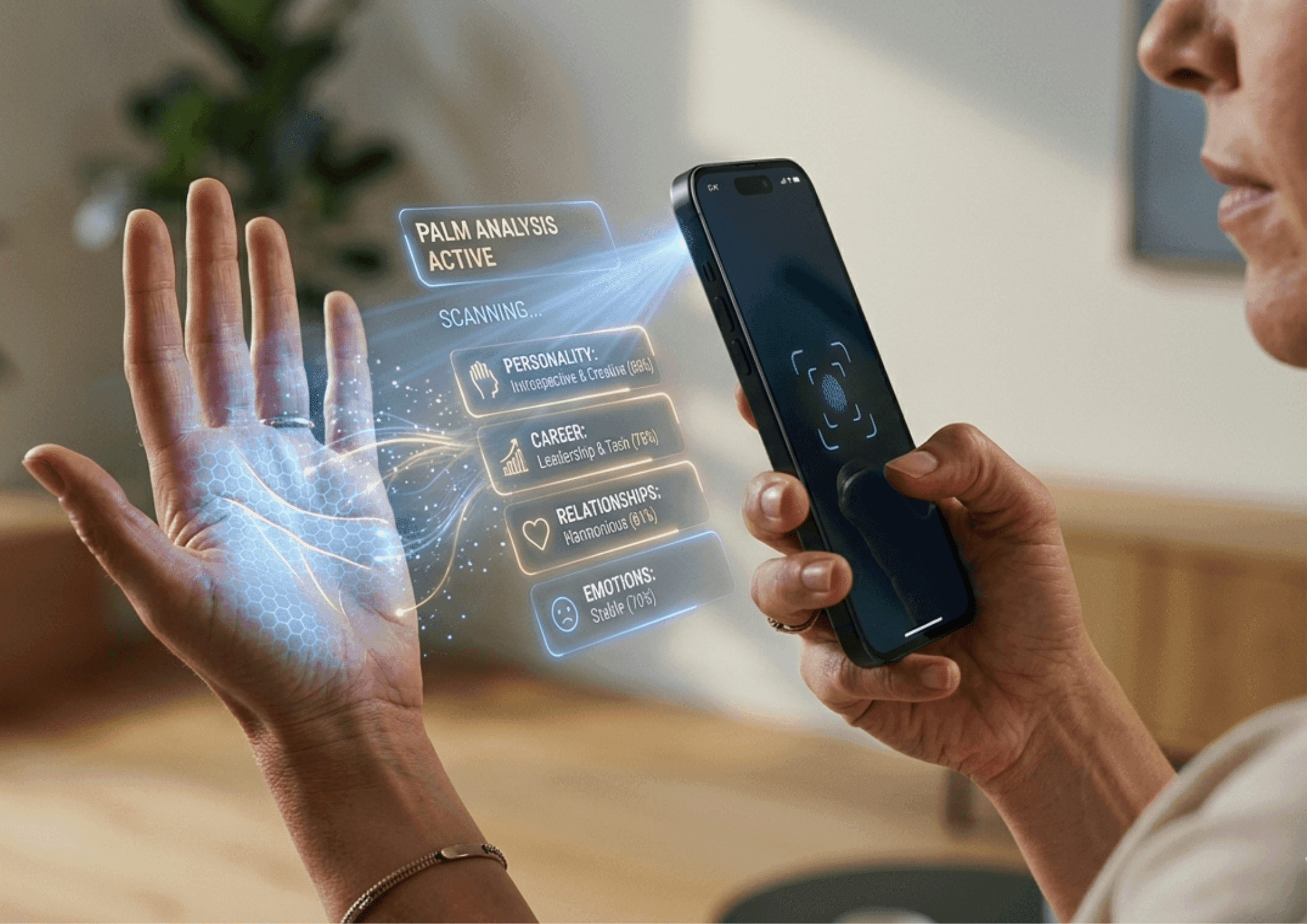
The rise of AI palm reading apps has brought an ancient practice to millions of smartphones worldwide. Point your camera at your palm, and within seconds an algorithm claims to reveal your personality, health, and destiny. But how accurate is this technology — and what does it miss compared to the rich tradition of Vedic palmistry, known as Hasta Samudrika Shastra? This guide breaks down exactly how AI palm reading works, where it falls short, and how to get genuine insight from your hand.
What Is AI Palm Reading and How Does It Work?
AI palm reading apps use computer vision and machine learning to analyze photographs of the hand. The process typically involves three stages: image capture, feature extraction, and interpretation.
During feature extraction, the algorithm identifies the major lines on the palm — primarily the heart line, head line, life line, and fate line. More advanced apps also attempt to detect hand shape and relative finger lengths. The system then matches these features against a trained dataset of labeled hand images and returns an interpretation based on pattern recognition.
Most apps are trained on Western palmistry conventions, mapping features to personality traits, relationship styles, and life tendencies. The output feels personalized, but it is fundamentally a pattern-matching exercise — not a nuanced reading.
What Vedic Palmistry Sees That AI Currently Misses
Traditional palmistry in India — Hasta Samudrika Shastra — treats the hand as a living map that combines lines, mounts, marks, skin texture, nail condition, and even the flexibility of fingers. Current AI palm reading tools capture only a fraction of this picture.
Consider the Parvat (mounts) — the fleshy pads at the base of each finger and along the palm. In Vedic tradition, a well-developed Guru Parvat (Jupiter Mount, under the index finger) indicates leadership potential and moral authority. A prominent Chandra Parvat (Moon Mount, on the outer edge of the palm) points to deep intuition and creative imagination. No camera app currently assesses mount elevation, firmness, or the quality of lines that cross them.
Equally invisible to AI are the Shubh Chinh (auspicious marks) — special formations that carry precise meanings in the Vedic system. A Trishul (trident) at the tip of a mount indicates divine grace. A Matsya (fish sign) near the wrist suggests prosperity and spiritual wisdom in later life. A Chakra (wheel) on the Guru Parvat is a classical marker of a leader destined for influence. These signs require careful visual inspection and cannot yet be reliably detected by image recognition algorithms.
Skin texture, nail ridging, thumb flexibility, and the color of the palm across different zones also provide diagnostic information in the Vedic tradition — dimensions that remain entirely outside the scope of current AI palm reading technology.
The Lines AI Palm Reading Apps Focus On
Most AI palm reading tools concentrate on the four major lines, which do correspond to important markers in Hasta Samudrika Shastra:
-
Jeevan Rekha (Life Line): Curves around the base of the thumb. In Vedic tradition, it speaks to vitality, major life transitions, and the quality of health — not the length of life as popular myth suggests. AI apps can detect this line reliably, but struggle to interpret branches, islands, or chains along its course.
-
Hridaya Rekha (Heart Line): Runs horizontally across the upper palm. It governs emotional nature, the capacity for love, and one's relationship patterns. AI can locate it, but a Vedic reader also examines where it terminates — whether it ends under Guru Parvat (idealistic love) or Shani Parvat (Saturn Mount, suggesting emotional restraint).
-
Mastishk Rekha (Head Line): Crosses the middle of the palm and reflects intellect, decision-making style, and mental focus. A sloping head line toward Chandra Parvat suggests creative and intuitive thinking; a straight line indicates logical, analytical tendencies.
-
Bhagya Rekha (Fate Line): Rises from the base of the palm toward the middle finger. This line relates to career trajectory, external circumstances, and the role of karma in one's professional life. It is often faint or absent — which itself carries meaning, something AI apps frequently misinterpret as a data gap rather than a significant reading.
AI performs reasonably well at detecting whether these lines are present and roughly tracing their paths. The gap appears in interpretation: the quality of a line (deep, chained, broken, fringed), the marks that intersect it, and its relationship to the mounts require the trained eye of a practitioner.
Can AI Palm Reading Be Accurate?
The honest answer is: partially, and within limits.
The scientific basis for palmistry lies in dermatoglyphics — the study of skin ridge patterns and their relationship to genetics, prenatal development, and certain health conditions. Research confirms that hand features carry real biological information. However, the leap from biological markers to personality and destiny predictions is where both AI apps and some human practitioners overreach.
What AI palm reading can do reasonably well is pattern-match against large datasets to surface probabilistic tendencies — similar to how personality questionnaires work. If you understand the output as a probabilistic sketch rather than a definitive forecast, the technology has genuine utility as a reflective tool.
What it cannot do is replicate the holistic synthesis of a skilled Vedic palmist, who weighs dozens of variables simultaneously, accounts for the hand's dominant side, observes changes over time, and brings the contextual wisdom of Hasta Samudrika Shastra to bear.
How to Get the Most from AI Palm Reading Tools
If you want to explore AI palm reading meaningfully, keep these principles in mind:
-
Use your dominant hand for career, personality, and current life trajectory; use the non-dominant hand for inherited tendencies and potential.
-
Take the photo in good natural light with the palm flat and fully extended — shadows distort line detection significantly.
-
Treat the output as a starting point, not a verdict. Use it to identify which lines and areas of your hand warrant deeper exploration.
-
Cross-reference with Vedic tradition. If an app highlights a strong fate line, look into what Bhagya Rekha means in the classical texts — the context is far richer than any app currently provides.
-
Note what the app ignores: mounts, special marks, finger phalanges, and skin quality. These are often where the most meaningful information lives.
Conclusion
AI palm reading represents an exciting entry point into the ancient science of hand analysis — one that is making palmistry traditions accessible to a global audience. But the technology is still in its early stages, capturing only the visible outline of a much deeper system. The major lines — Jeevan Rekha, Hridaya Rekha, Mastishk Rekha, and Bhagya Rekha — are only the beginning. The mounts, the Shubh Chinh, the texture and flexibility of the hand: these dimensions of AI palm reading remain largely unexplored by current apps.
For a reading that goes beyond the algorithm, Palmyst combines the depth of Hasta Samudrika Shastra with the convenience of a modern platform — so you can move from curiosity to genuine understanding.
%2FfB37dUEG12bQGRFmiRnIwLqqEI.jpeg&w=3840&q=75)