
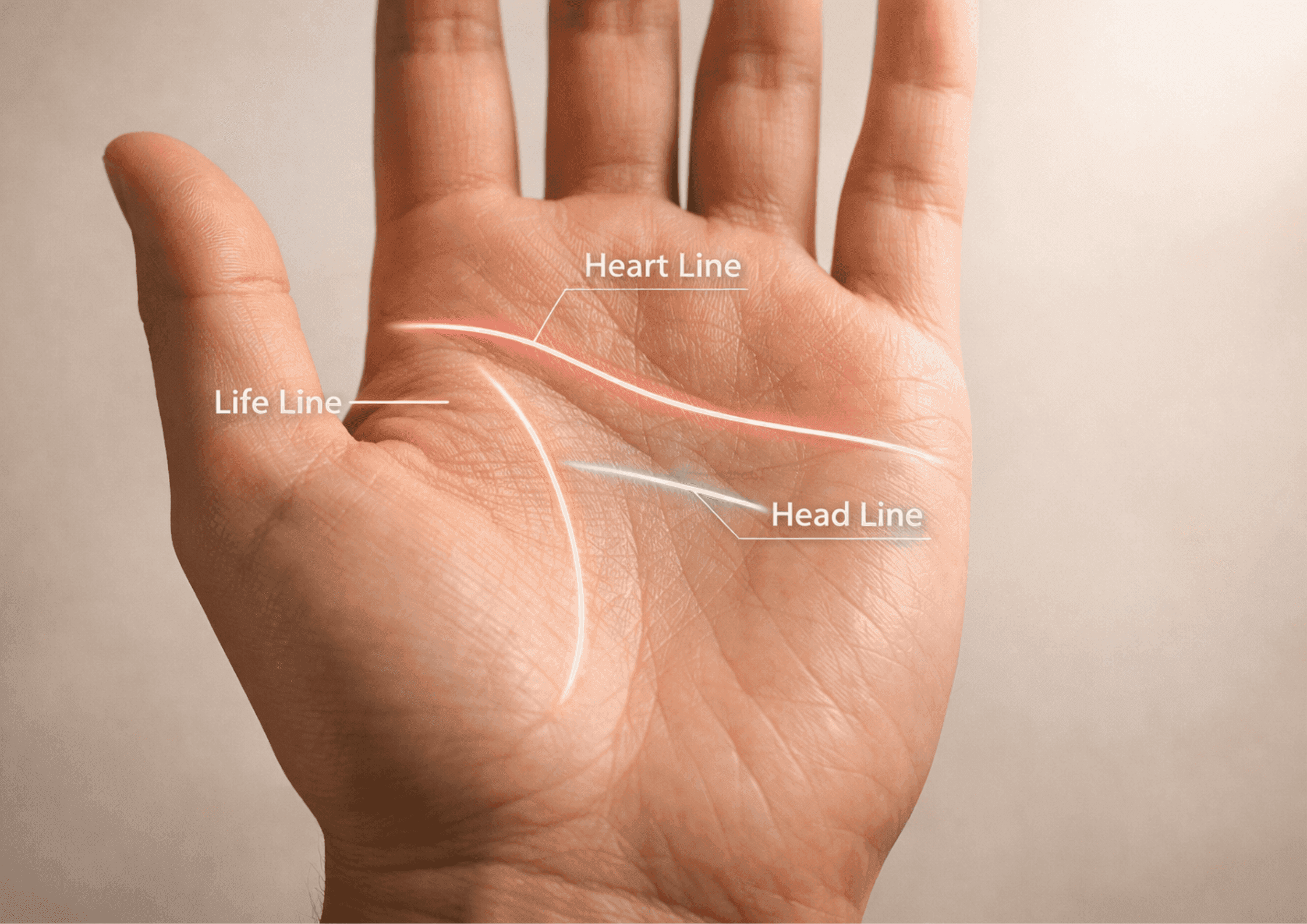
Have you ever looked at your palm and wondered what those lines mean? You are not alone. For thousands of years, people across cultures have studied the lines on the hand to understand personality, health, relationships, and destiny. Learning how to read palm lines is easier than most people think — and the insights can be surprisingly accurate.
This guide walks you through the major palm lines using the principles of Hasta Samudrika Shastra, the ancient Vedic science of hand reading. Whether you are reading your own palm or someone else's, this is where you start.
Before You Begin: Which Hand Do You Read?
One of the first questions beginners ask is: left hand or right hand?
In Vedic palmistry, the passive hand (usually the left for right-handed people) shows the potential you were born with — your natural tendencies, inherited traits, and karmic blueprint. The active hand (your dominant hand) shows how life has shaped you — choices made, habits formed, and the path you are currently on.
For a complete reading, compare both hands. If the lines differ significantly between them, it signals that the person has worked hard to change their natural path — for better or worse.
The Four Major Palm Lines at a Glance
Before diving into each line, here is a quick reference:
Vedic Name
English Name
What It Reveals
Jeevan Rekha
Life Line
Vitality, energy, major life transitions
Hridaya Rekha
Heart Line
Emotions, love style, relationships
Mastishk Rekha
Head Line
Thinking style, focus, decision-making
Bhagya Rekha
Fate Line
Career, life direction, destiny
These four lines form the foundation of how to read palm lines. Most palms show all four, though the fate line can be faint or absent in some people.
Reading the Life Line (Jeevan Rekha)
The Jeevan Rekha, or life line, curves around the base of the thumb, sweeping down toward the wrist. It is usually the easiest line to find.
Common myths: Many people believe a short life line means a short life. This is not true in Vedic palmistry. The life line reflects the quality and energy of your life — not its length.
What to look for:
-
Deep and clear: Strong vitality, good physical health, and resilience
-
Faint or thin: Sensitive constitution, may need to manage energy carefully
-
Long curve sweeping wide: Adventurous, energetic, loves physical activity
-
Tight curve close to the thumb: Cautious, prefers security over risk
-
Breaks in the line: Major life transitions, not necessarily illness — could be a move, career change, or significant relationship shift
-
Islands on the line: Periods of stress or scattered energy
The mount that the Jeevan Rekha encircles — Shukra Parvat (the Mount of Venus) — adds important context. A well-developed Shukra Parvat beneath a strong life line suggests warmth, creativity, and strong personal relationships.
Reading the Heart Line (Hridaya Rekha)
The Hridaya Rekha, or heart line, runs horizontally across the upper palm, below the fingers. It governs your emotional world — how you love, what you need in relationships, and how you express feelings.
Where it starts and ends matters:
-
Starts below the index finger (Tarjani / Jupiter finger): Idealistic in love, seeks deep meaning in relationships
-
Starts below the middle finger (Madhyama / Saturn finger): More pragmatic and self-directed in love
-
Long line reaching the index finger area: Devoted, emotionally generous
-
Short line: More private with feelings, not necessarily cold
Curve vs. straight:
-
Curved upward: Warm, expressive, physically affectionate
-
Straight or flat: Analytical in love, values intellectual connection
Breaks or chains on the Hridaya Rekha can indicate emotional turbulence or significant relationship changes. A forked end is considered auspicious — it suggests balance between heart and mind.
Reading the Head Line (Mastishk Rekha)
The Mastishk Rekha, or head line, runs horizontally across the middle of the palm. It reveals how you think — your mental style, focus, creativity, and approach to decisions.
Key things to observe:
-
Long and straight: Logical, focused, practical thinker — strong in analysis and detail
-
Long and sloping downward: Creative, imaginative, intuitive — often artistic or drawn to storytelling
-
Short: Makes quick decisions, action-oriented, not overthinking
-
Deep and clear: Excellent concentration, determined mind
-
Chained or wavy: Scattered thinking, many interests, difficulty with sustained focus
Connection to the life line at the start:
-
Joined at the start: Cautious early in life, heavily influenced by family in formative years
-
Separate at the start: Independent thinker from a young age, confident and self-directed
The slope of the Mastishk Rekha toward Chandra Parvat (the Mount of the Moon) is a classic sign of a vivid imagination — common in writers, artists, and spiritually inclined people.
Reading the Fate Line (Bhagya Rekha)
The Bhagya Rekha, or fate line, rises vertically from the base of the palm toward the middle finger. Not everyone has a prominent fate line — and that is perfectly fine. Its absence simply means the person's life path is more self-made and less driven by external circumstances.
Where it starts:
-
From the base of the palm (wrist area): Career path defined early in life
-
From the middle of the palm: Career direction becomes clearer in the mid-twenties to thirties
-
Rising from the life line: Early life strongly shaped by family; independence comes later
What the line reveals:
-
Strong and unbroken: Steady career, clear sense of purpose
-
Breaks and restarts: Career changes, pivots — not failures, just shifts in direction
-
Double fate line: Multiple careers or income streams running simultaneously
-
Merging with the life line midway: A period where personal and professional life deeply intertwine
Beyond the Lines: Mounts and Special Marks
Learning how to read palm lines is just the beginning. The Parvat (mounts) — the fleshy raised areas beneath each finger — amplify or reduce the energy of the lines that pass through them.
For example, a strong Guru Parvat (Mount of Jupiter, below the index finger) paired with a clear fate line points to leadership potential and public recognition. A well-developed Budha Parvat (Mount of Mercury, below the little finger) enhances communication and business ability.
Look also for Shubh Chinh — auspicious special marks. A Trishul (trident) at the top of the fate line near Shani Parvat (Mount of Saturn) is considered a powerful sign of career success and divine grace. A star mark on any mount indicates sudden brilliance or fame in that area of life.
These details elevate a basic palm reading into a genuinely personal and accurate analysis.
How to Read Palm Lines: A Quick Practice Checklist
-
Choose the active hand for your current life; passive hand for innate potential
-
Identify the four major lines: Jeevan, Hridaya, Mastishk, Bhagya Rekha
-
Observe the depth, length, and clarity of each line
-
Note any breaks, islands, branches, or forks
-
Check the mounts for how they influence each line
-
Look for any special marks (Shubh Chinh) on mounts or lines
Start Your Palm Reading Journey with Palmyst
Reading your own palm takes practice, but the more you observe, the more patterns emerge. Each hand is unique — and that is exactly what makes palmistry so powerful as a tool for self-understanding.
If you want a detailed, AI-powered reading of your palm that covers career, relationships, personality, and more, Palmyst makes it easy. Simply upload a photo of your palm and receive a personalized report grounded in the wisdom of Hasta Samudrika Shastra. Your lines have a story — Palmyst helps you read it.

%2FfB37dUEG12bQGRFmiRnIwLqqEI.jpeg&w=3840&q=75)