
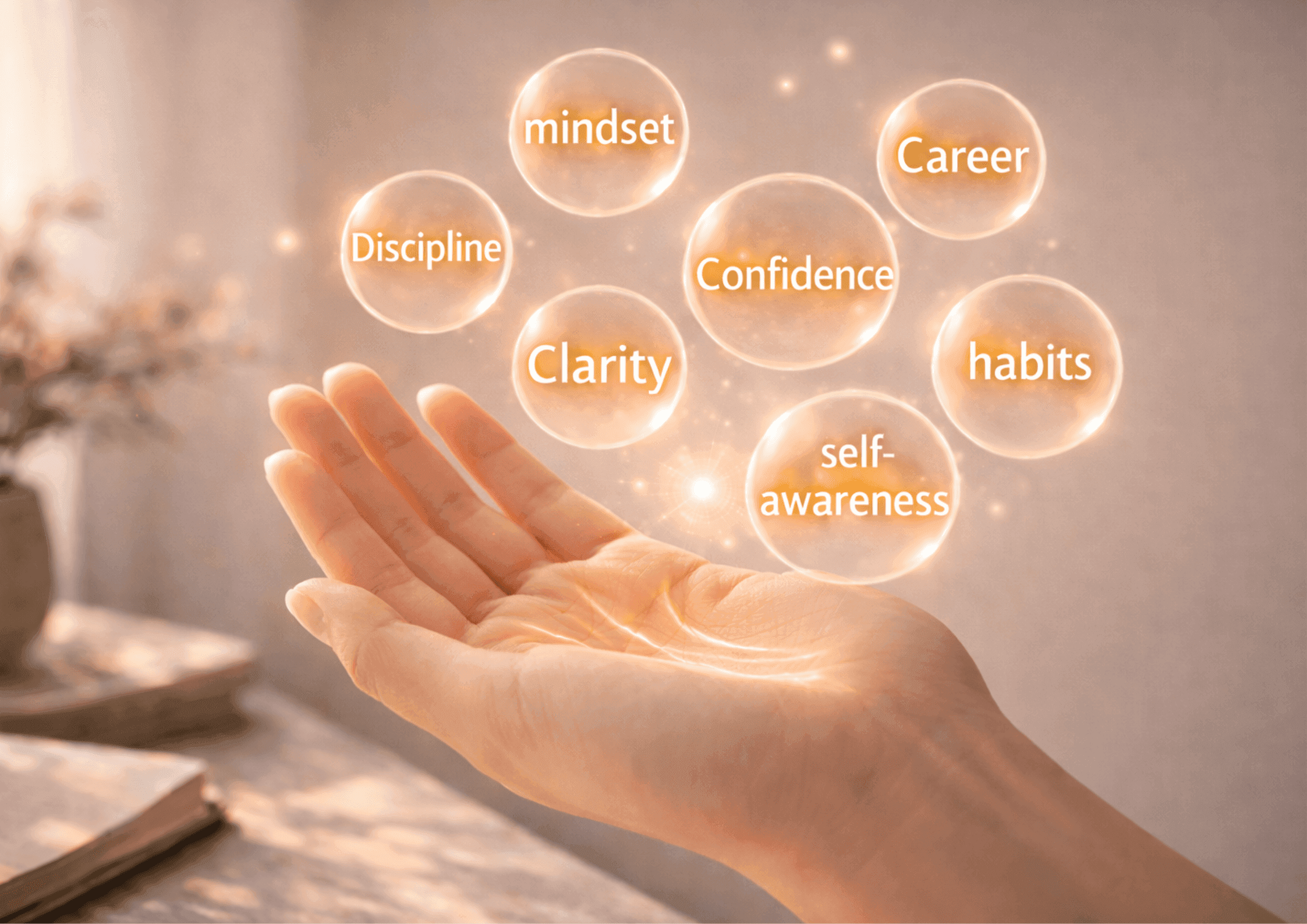
Most people turn to palmistry looking for answers about love or luck. But in Vedic tradition, the hand has always been a deeper instrument — a map of character, discipline, and potential. Palm reading for personal growth isn't about predicting your future; it's about understanding who you are right now, and what patterns may be holding you back or propelling you forward.
Hasta Samudrika Shastra, the ancient Indian science of hand reading, treats the palm as a reflection of the inner self. The lines, mounts, and marks on your hand shift over time — because you do. Using palmistry as a mirror for self-improvement is one of the most practical ways to engage with this tradition.
The Head Line (Mastishk Rekha): A Map of Your Mindset
In Vedic palmistry, the Mastishk Rekha — or Head Line — is considered the most important indicator of mental constitution. It runs horizontally across the middle of the palm and reveals how you think, make decisions, and process challenges.
What to look for:
-
Long and straight: Analytical, logical mindset. Strong capacity for focused work and systematic habit-building. Can struggle with overthinking or rigidity.
-
Curved downward toward the Chandra Parvat (Moon Mount): Creative, intuitive thinker. Excellent imagination but may lack follow-through without structure.
-
Short: Quick, instinctive decision-maker. Practical and action-oriented — but may benefit from pausing before committing.
-
Chained or broken: Periods of mental distraction, scattered focus, or difficulty with consistency. Often corresponds to times of internal transition.
A deep, clear Mastishk Rekha signals strong mental resilience — an asset in any self-improvement journey. If yours appears faint or fragmented, that's not a verdict; it's an invitation to build focus through intentional practice.
The Fate Line (Bhagya Rekha): Career Direction and Adaptability
The Bhagya Rekha — Fate Line — runs vertically up the palm, often from the wrist toward the middle finger. It is one of the most consulted lines for career and professional growth.
Key readings:
-
Strong, unbroken line from the base of the palm: A clear sense of direction and purpose from early in life. Career momentum tends to build steadily.
-
Fate line beginning mid-palm: Career finds its stride in the late 20s or 30s — common in people who pivoted or discovered their calling later.
-
Multiple fate lines: Versatility and multiple income streams or careers. Reflects someone adaptable and entrepreneurially minded.
-
Absent or very faint: Not a negative sign. Many successful people have indistinct fate lines, indicating that their path is self-created rather than preordained.
Breaks in the Bhagya Rekha often correspond to significant career transitions. Rather than reading these as failures, Vedic tradition views them as chapter shifts — moments where external circumstance forced internal evolution.
Mounts of Jupiter and Saturn: Confidence and Discipline
Two mounts are especially relevant to personal development: the Guru Parvat (Mount of Jupiter, beneath the index finger) and the Shani Parvat (Mount of Saturn, beneath the middle finger).
Guru Parvat — The Seat of Confidence
A well-developed Guru Parvat indicates:
-
Natural leadership ability and personal authority
-
Ambition backed by self-belief
-
A tendency to inspire others
If this mount is flat or underdeveloped, confidence may need to be built consciously — through action, achievement, and deliberate exposure to challenge.
Shani Parvat — The Foundation of Habit
The Mount of Saturn governs discipline, karma, and perseverance — the very qualities that make habits stick.
-
A firm, well-formed Shani Parvat suggests natural discipline and the ability to delay gratification
-
An overdeveloped mount can tip into rigidity or excessive self-criticism
-
Underdevelopment may point to difficulty maintaining long-term habits, even when the intention is strong
Together, these two mounts reveal the balance between wanting to grow (Jupiter) and doing the work to grow (Saturn) — a tension every self-improvement journey navigates.
Auspicious Marks That Signal Turning Points
Vedic palmistry identifies specific Shubh Chinh (auspicious marks) that can appear on lines or mounts and carry significant meaning for personal development.
Mark
Where Found
Meaning
Trishul (trident)
Tip of fate line or Sun mount
Exceptional blessing; unusual achievement potential
Chakra (wheel/circle)
Mount of Jupiter or fingertips
Leadership destiny; capacity to influence many
Tara (star)
Head line or mount of Mercury
Sudden recognition; a breakthrough moment in career or reputation
Matsya Rekha (fish line)
Near the wrist or base of palm
Long-term prosperity and spiritual depth
These marks are rare and should be examined carefully. A single star on the Mastishk Rekha, for instance, can indicate a significant mental breakthrough or a moment where your thinking shifted permanently.
Using Your Palm Reading as a Self-Improvement Tool
Palmistry works best not as a fortune-telling device but as a structured reflection practice. Here's how to make it practical:
-
Study your Head Line first. It reveals your dominant thinking style. If it curves strongly toward the moon mount, you may need more structure to convert ideas into habits. If it runs straight, you may need to deliberately build in creativity and flexibility.
-
Check your Fate Line for patterns. Are there breaks? When did they occur? Cross-reference them with career transitions you've actually experienced. This builds trust in the practice and reveals how your external changes reflect internal shifts.
-
Assess both mounts. Are Guru Parvat and Shani Parvat balanced? An ambitious person with a flat Saturn mount may struggle to maintain routines. A disciplined person with a flat Jupiter mount may undervalue themselves.
-
Look for auspicious marks as encouragement. A Trishul or Chakra isn't a guarantee — it's a signal of potential that still requires activation through effort.
-
Revisit every 6–12 months. Lines genuinely change over time, especially the Head Line and Fate Line. Tracking these changes can be a motivating reminder that growth is happening.
Your Hand Is Already Telling You Something
Palm reading for personal growth is one of the oldest forms of self-inquiry in Indian tradition. The Mastishk Rekha maps your mindset. The Bhagya Rekha reflects your career rhythm. The Guru and Shani Parvats reveal your relationship with confidence and discipline. And the auspicious Shubh Chinh remind you that potential — even exceptional potential — is already written into your hand.
You don't need to change who you are. You need to understand who you are more clearly.
Palmyst makes this exploration accessible and accurate — offering AI-powered Vedic palm readings that go beyond surface-level interpretations. Upload your palm and discover what your hand is already trying to tell you.

%2FfB37dUEG12bQGRFmiRnIwLqqEI.jpeg&w=3840&q=75)